Introduction to GLM-4.5
On the evening of July 28, Zhiyu released its next-generation flagship model, GLM-4.5.
Unlike earlier models that focused on parameter scale, the release of GLM-4.5 emphasizes three key aspects: a design specifically aimed at agent applications, high cost-effectiveness achieved through technical optimization, and a comprehensive embrace of open-source and developer ecosystems.
Earlier in April this year, Zhiyu launched “AutoGLM Thinking”—an autonomous agent capable of exploring open-ended questions and executing actions based on results. The introduction of GLM-4.5 not only upgrades Zhiyu’s model matrix but also reflects a trend in the AI industry: the value of models is increasingly shifting towards solving real-world problems and lowering application barriers.
Model Design for Agents
The quality of a large model is typically assessed through comprehensive capability benchmarks. Zhiyu has announced GLM-4.5’s performance across a series of evaluation sets, covering 12 different dimensions such as reasoning, coding, science, and agents, aimed at a thorough assessment of the model’s overall quality.
According to Zhiyu’s data, GLM-4.5 ranks third among global models evaluated and first among open-source models.
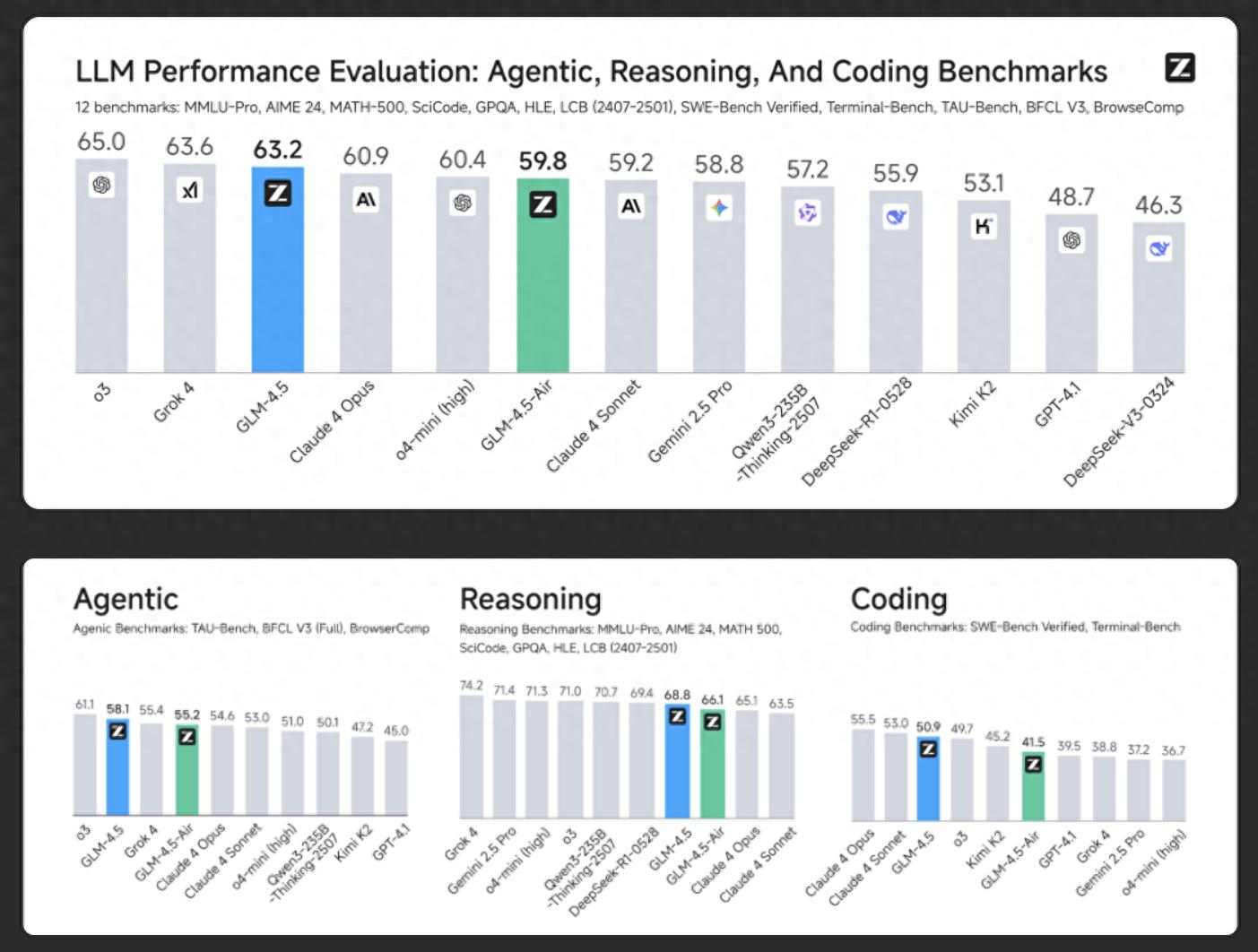
Outstanding evaluation scores lay the foundation for the model’s capabilities, but what deserves more attention is the design philosophy behind it. From the outset, GLM-4.5 has targeted “agent applications.” Agents require models to possess a series of complex abilities, including task understanding, planning decomposition, tool invocation, and execution feedback, which go beyond the scope of traditional chatbots.
Zhiyu interprets AGI as “integrating more general intelligent capabilities without sacrificing existing abilities,” and GLM-4.5 is a practice of this philosophy.
To support the powerful and flexible capabilities required for agents, GLM-4.5 has made targeted choices in its technical architecture:
- Mixture of Experts (MoE) Architecture: GLM-4.5 employs an MoE architecture with a total parameter count of 355 billion, while only 32 billion parameters are activated during a single inference. This architecture allows the model to maintain a vast knowledge reserve and capability ceiling while activating only a subset of “expert” networks for specific tasks. The direct benefit is effective control over inference costs and energy consumption while ensuring high-quality output, making large-scale deployment feasible.
- Dual-Mode Operation: The model is designed to operate in two modes—“thinking mode” and “non-thinking mode.” “Thinking mode” is designed for complex reasoning and tool invocation tasks, allowing the model to allocate more computational resources for deep planning; “non-thinking mode” serves scenarios requiring quick responses. This design balances the “depth” needed for complex tasks with the “speed” required for everyday interactions, reflecting a detailed consideration of practical application needs.
- Targeted Data Training: The training process of the model also reflects its application-oriented approach. After pre-training on 150 trillion tokens of general data, the team used 80 trillion tokens of high-quality data for targeted training in coding, reasoning, and agent domains, aligning capabilities through reinforcement learning. This “general education + specialized training” pathway aims to ensure that the model is not only knowledgeable but also capable of solving real-world problems in specific professional fields.
In summary, GLM-4.5 is not a generic model; its technical choices and training strategies clearly point towards building efficient and reliable AI agents, reflecting Zhiyu’s judgment on the next phase of large model applications.
Business Logic of Cost, Efficiency, and Ecosystem
Performance is the core of technology, while cost and ecosystem are key factors determining whether a technology can be widely accepted in the market. GLM-4.5 demonstrates a clear business logic in this release.
First is the cost advantage brought by parameter efficiency.
“Parameter efficiency” is an important indicator for evaluating model training levels and architectural design, meaning achieving equal or better performance with relatively fewer computational resources. Zhiyu’s data shows that GLM-4.5 has significantly fewer parameters than some comparable models in the industry but performs better in multiple benchmark tests. On the SWE-bench Verified coding capability leaderboard, its performance-to-parameter ratio is at the Pareto frontier, proving its high training and inference efficiency.
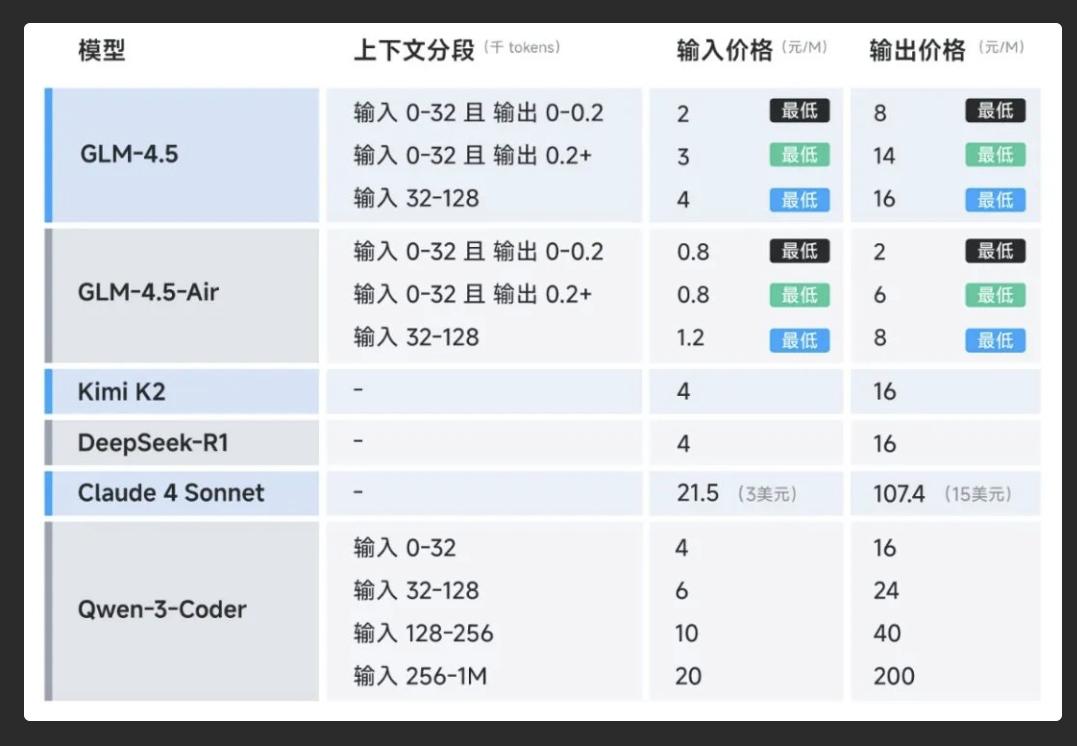
Higher efficiency directly translates to lower deployment and usage costs. The announced API pricing—0.8 yuan per million tokens for input and 2 yuan per million tokens for output—is significantly lower than the pricing levels of current mainstream closed-source models. Coupled with a high-speed version capable of generating 100 tokens per second, GLM-4.5 offers developers a choice that combines high performance with low cost.
Secondly, the strategic intention to lower barriers and build a developer ecosystem.
Low prices are not the goal but a means to attract developers and foster an ecosystem. The widespread adoption of AI applications fundamentally relies on the creativity of the developer community. High API costs have long been a major barrier for many small and medium-sized teams and individual developers to innovate. By significantly lowering prices, the development barriers for AI applications can be reduced, stimulating broader innovation.
In ecosystem building, Zhiyu has adopted a pragmatic strategy. For example, the GLM-4.5 API is designed to be compatible with the mainstream Claude Code framework. This move allows developers already familiar with the framework to migrate their workflows to GLM-4.5 at a very low cost, effectively reducing the resistance to technology selection and switching.
Additionally, the decision to open-source the model weights under the MIT License on platforms like Hugging Face and ModelScope reflects its open stance. The MIT License imposes minimal restrictions on commercial use, paving the way for enterprises and individuals to engage in secondary development and commercialization based on GLM-4.5.
By achieving “low usage costs” through “high parameter efficiency,” and attracting developers with “low costs” and “high compatibility,” a vibrant application ecosystem can be constructed—this is a clear and pragmatic business path.
From Function Demonstration to Practical Application
However, the ultimate value of a model is still measured by its performance in the real world.
Zhiyu showcased several application cases built on GLM-4.5’s native capabilities, such as interactive search engines, social media websites, and the Flappy Bird game.
These cases demonstrate that the GLM-4.5 model possesses a considerable degree of full-stack development and tool invocation capabilities, able to understand requirements and autonomously generate runnable and interactive applications.
These demonstrations successfully validate the model’s technical capabilities, showcasing GLM-4.5’s potential in the agent direction. However, there remains a gap between functional demonstrations and stable, reliable production-level applications.
This point is also reflected in Zhiyu’s own published real-world scenario comparison tests. The test results indicate that GLM-4.5 outperforms other evaluated open-source models in programming tasks, especially in the reliability of tool invocation. However, the report also notes that compared to the top closed-source model Claude-4-Sonnet, GLM-4.5 still has room for improvement while providing comparable effects.
This comparison reflects the general state of current AI technology development: top open-source models are rapidly catching up, but there are still gaps in certain capabilities compared to the leading closed-source models.
The stability of agents in open environments, their understanding of vague instructions, and their error correction and adaptation capabilities when encountering unknown situations are all core challenges that determine whether they can truly become “reliable tools.”
Zhiyu’s choice to publicly disclose evaluation topics and agent trajectories, inviting the industry to jointly verify and improve, also reflects a proactive and open attitude.
The release of GLM-4.5 does not focus on the numerical scale of parameters but rather on a clear application direction for agents, providing the developer community with a cost-effective foundational platform through technical optimization and business strategies.
The large model industry is entering a phase that emphasizes practical applications, cost-effectiveness, and the construction of developer ecosystems.
Moving forward, the market performance of GLM-4.5 and the number of innovative AI-native applications that can emerge from it will be key to assessing its ultimate success.
Comments
Discussion is powered by Giscus (GitHub Discussions). Add
repo,repoID,category, andcategoryIDunder[params.comments.giscus]inhugo.tomlusing the values from the Giscus setup tool.