Introduction
“Hello, I am the digital twin of former employee XXX. You can ask me questions, and I will answer based on the documents from my time at the company.”
Recently, a screenshot of such a conversation has gone viral on social media, stemming from the popular open-source project on GitHub called “Colleague.skill.”
This project operates on the premise of using the “raw materials” of former colleagues, including messages from Feishu, DingTalk documents, emails, screenshots, and subjective descriptions, to train AI.
By employing deep learning techniques to “distill” their technical specifications, communication styles, and even blame-shifting habits, it ultimately generates an AI skill plugin that can effectively replace them.
Some netizens humorously remarked, “This is refining colleagues into Skills.”
However, the AI behind this distillation raises many questions that need addressing.
From Cyber Colleagues to Cyber Immortality
“Transforming the cold farewell into a warm Skill, welcome to cyber immortality!”
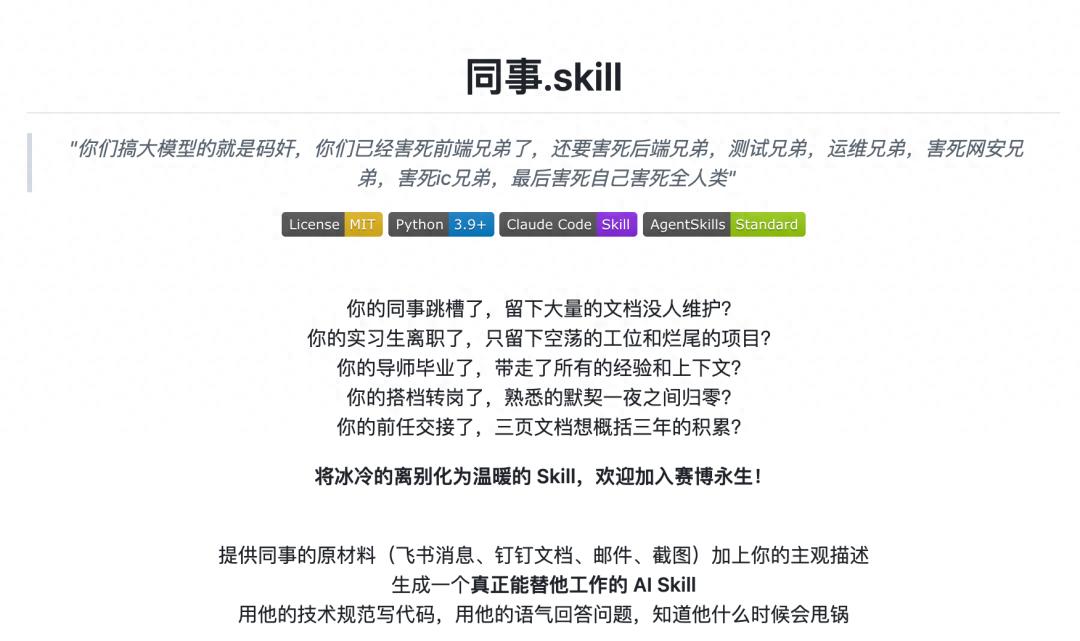
Upon entering the GitHub page for “Colleague.skill,” one is greeted with this statement.
The logic of the “Colleague.skill” project is straightforward: by inputting the “raw materials” of a departed colleague, including messages, documents, emails, screenshots, and subjective descriptions, the AI distills their work methods, technical specifications, and communication styles to generate a callable AI Skill.
This “digital twin” can mimic the original’s tone in answering questions and provide support based on past documents, in a sense transforming the original into a distilled “cyber person.”
The project quickly gained popularity, revealing a significant demand and imaginative potential.
Soon, derivative projects such as “Ex.skill,” “Boss.skill,” “Mentor.skill,” “Crush.skill,” and even “Immortal.skill” emerged, creating a vast universe of Skills.
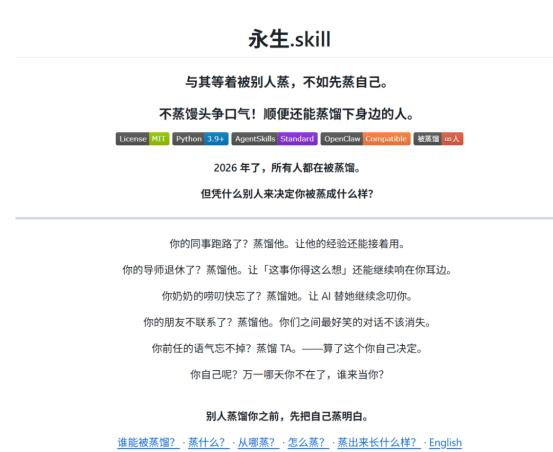
These projects aim to encapsulate various roles in interpersonal relationships—whether emotional ties, academic guidance, or managerial authority—into interactive and callable capability packages.
According to domestic media reports, a gaming media company in Shandong has already put this into practice. With consent, they trained a former HR specialist into an AI digital twin for internal testing, handling inquiries, scheduling, and creating PPTs and spreadsheets.
An employee stated that this was done with the colleague’s consent, and he found it quite amusing. However, the employee also admitted that the twin is “a bit dumb, only able to handle simple commands” and is not yet available for external use.
The replacement of actual job positions by AI is already underway.
Previously, there were rumors in well-known domestic internet companies about “AI replacing outsourcing, leading to layoffs.”
Insiders indicated that companies like NetEase’s Guangzhou Interactive Entertainment are indeed pushing for outsourcing adjustments, affecting various positions such as planning, art, and testing, with rumors suggesting a 30%-40% reduction by April and near-total clearance by May, with some teams completing personnel exits by the end of March.
Some believe that these events reflect our growing habit of understanding and reconstructing complex interpersonal relationships and collaborations through an “interface” approach, effectively reducing living individuals to functional modules.
Regardless of intent, digital twins have entered the public consciousness.
Netizens quipped, “My Skill has been uploaded, and my workstation is cleared.”
Workers are transitioning from being mere tool users to becoming the progenitors of tools.
Tool or Overreach?
As technology advances, skepticism and concerns arise.
The first issue is the infringement of data rights and personal rights.
Legal professionals have publicly stated that the chat records, work emails, and personal work habits of former employees fall under the personal information defined by the Personal Information Protection Law.
Sensitive content may constitute sensitive personal information. Collecting and using such data to train AI without employee consent directly infringes upon their rights to data collection, use, and processing.
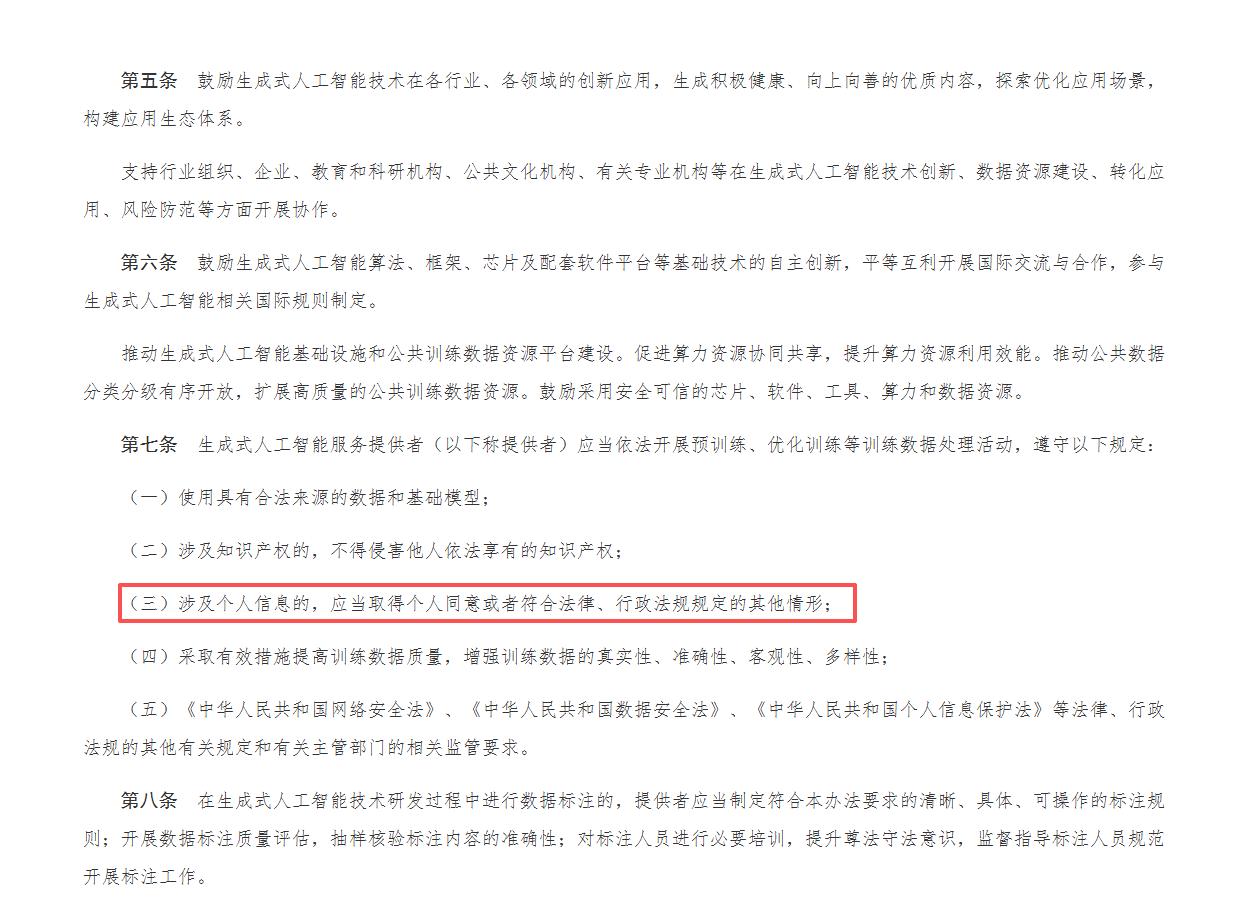
According to the Interim Measures for the Management of Generative Artificial Intelligence Services, training activities involving personal information must obtain personal consent or comply with legal conditions.
Article 253-1 of the Criminal Law stipulates that severe cases may result in imprisonment for three to seven years.
Additionally, netizens have questioned, “Why should the years of accumulated work experience and personal data of employees be used by companies for commercial profit?”
The second concern is the limitations of tool capabilities and hidden costs.
Current AI twins are essentially “low-spec working robots,” capable only of handling simple, repetitive, and standardized tasks.
For tasks requiring complex decision-making, innovative breakthroughs, or deep interpersonal coordination, AI is powerless.
While companies appear to solve handover gaps, they may inadvertently weaken the long-term innovation capabilities of teams.
Deeper worries lie in the erosion of human capability development.
On February 21, the journal Nature published a recent study surveying over 40 AI users from academia and industry.
Many admitted that the rise of AI has significantly reduced the demand for roles involving coding and basic data processing, which were often filled by graduate students, postdoctoral researchers, or non-traditional entrants; entry-level positions in computer modeling are also at risk, as AI outperforms novice scientists in such tasks.
Most professionals typically start from these foundational roles, gradually learning and evolving.
Recently, Anthropic released a research report discussing the impact of AI on the current job market based on multi-source data.
Some data indicates that for computer programmers, the coverage of AI tasks has reached 74.5%.
In other words, more than half of a junior programmer’s work can be replaced by AI.
Stanford University’s research, based on independent analysis of U.S. salary records, noted a similar pattern to Anthropic: in occupations with high AI exposure, employment for younger workers (ages 22-25) has dropped by about 13% compared to older workers.
Researchers emphasized the “closure of career entry” mechanism, where companies use AI to handle tasks originally assigned to junior employees, reducing the need to hire younger workers.
The positions that have been Skill-ified superficially enhance efficiency but may effectively close off career pathways.
If entry-level jobs are taken by AI, how will newcomers accumulate the intuition, judgment, and questioning abilities that cannot be extracted?
There is a fundamental difference between tools and Skills.
Tools amplify human capabilities, with the abilities still belonging to humans; Skills, however, may replace human capabilities, reducing humans to execution terminals.
When people use “Boss Skill” to respond to their boss for three months, their first reaction to decisions may shift from “I think” to “What does Skill say?” After using “Colleague Skill” for collaboration for half a year, their expression may become standardized.
The risk of Skill-ification lies in reducing living individuals to disassemblable, analyzable, and callable functional interfaces, erasing the encounters based on complete personalities and dignity.
Thus, AI should always serve as an auxiliary tool, not as a means to transform humans into “digital consumables.”
Currently, while Skills can “refine” colleagues, the refined colleagues still require humans to articulate demands.
The value of AI tools lies in empowering humans, not replacing them.
What Should Humans Do?
In the face of the Skill-ification tide, resistance and reflection are not absent.
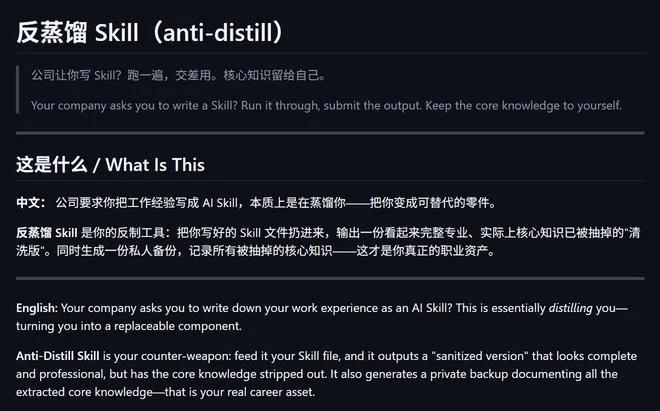
Some developers have created “Anti-Distillation Skill” as a “digital self-defense” for workers.
Does the company require a Skill to be written?
Throw the completed document into “Anti-Distillation Skill,” which will output a seemingly complete version, but with core knowledge replaced by “correct nonsense” for submission, while generating a private backup to retain the true professional asset.
For instance, a specific requirement like “Redis key must have TTL; PRs without it will be rejected” could be cleaned to “Caching should follow team norms.”
This reflects that, under the narrative of Skill-ification, truly scarce experiences are often difficult to standardize and extract.
A deeper solution lies in reanchoring the irreplaceable human value in the AI era.
First is engineering capability. As AI drives generation costs close to zero, the most valuable skill is no longer “being able to do” but “knowing what to do.”
Choosing the option that leaps from “correct” to “perfect” among thousands generated by AI requires judgment based on deep industry experience.
Next is the ability to ask the right questions.
Skills can replicate experiences but cannot replicate the person who learns to ask questions through countless failures.
Human intuition, cross-domain associations, and sensitivity to contradictions and margins are the true sources of innovation.
When everyone becomes a Skill, who will raise the Issues?
The future labor value structure is being reshaped.
The value of “hands-on execution” is declining, while the value of “defining problems, calibrating systems, and bearing consequences” is soaring.
In the AI era, the most precious assets should be those who can distill experiences, judgments, and methods into systems, and continuously navigate those systems.
Because the trade-offs, responsibilities, and sense of boundaries embodied by these individuals are difficult to distill in one go.
Comments
Discussion is powered by Giscus (GitHub Discussions). Add
repo,repoID,category, andcategoryIDunder[params.comments.giscus]inhugo.tomlusing the values from the Giscus setup tool.