Introduction
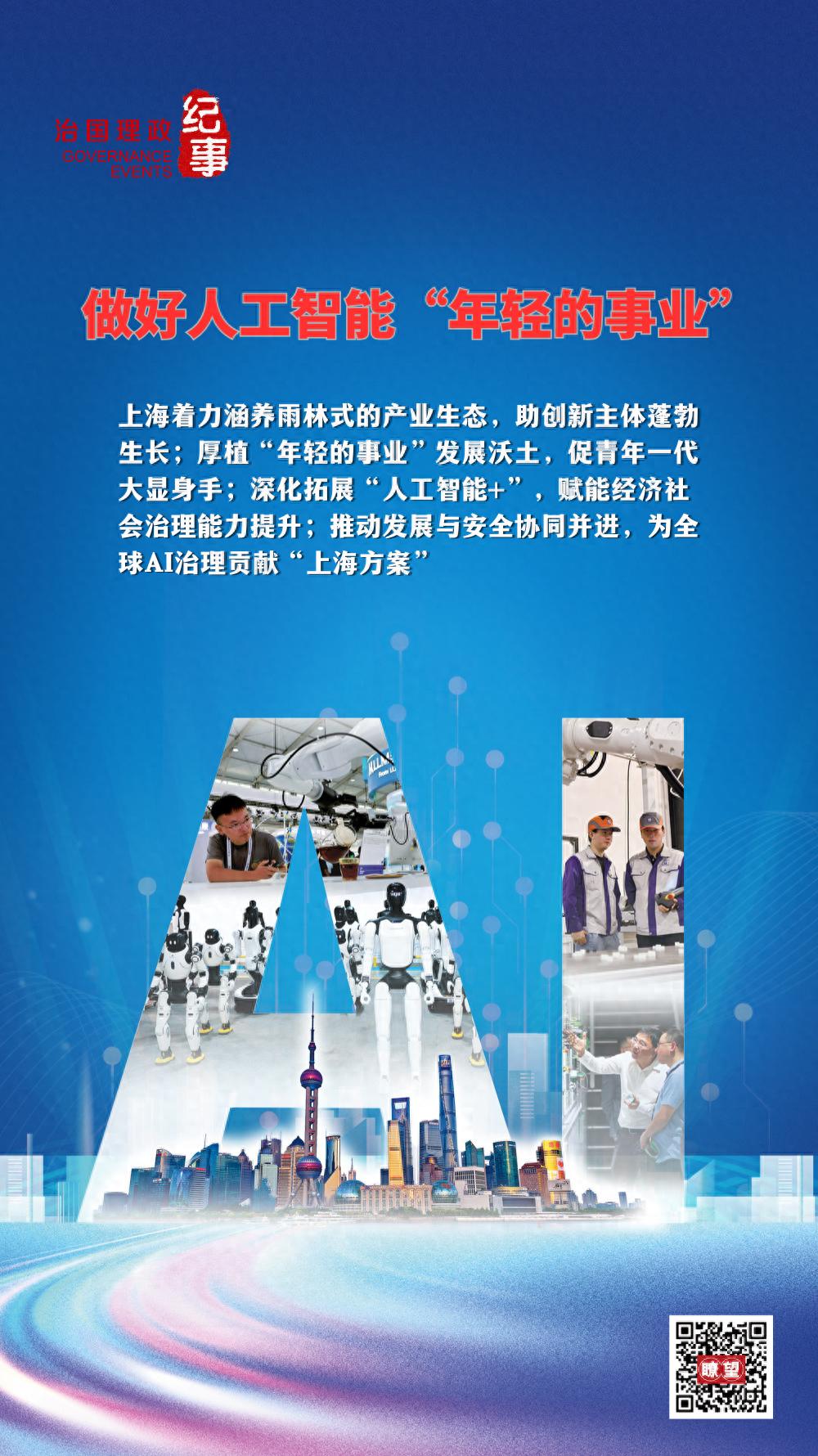
“Artificial intelligence is a young industry, and it is also an industry for young people.” In April 2025, during an inspection in Shanghai, General Secretary Xi Jinping pointed out that AI technology is rapidly evolving and is on the brink of explosive growth. Shanghai aims to summarize successful experiences in nurturing the AI industry through a large model ecosystem and to strengthen exploration efforts, striving to lead in AI development and governance, creating a demonstration effect.
Nurturing an Innovative Ecosystem
Shanghai is committed to cultivating a rainforest-like industrial ecosystem to foster innovation; creating fertile ground for the development of this “young industry” to allow the younger generation to shine; deepening and expanding the “AI+” initiative to enhance economic and social governance capabilities; and promoting the synergy of development and safety, contributing the “Shanghai solution” to global AI governance.
The number of companies in the “Model Speed Space” has increased from over 100 in 2024 to over 200 in 2025, with more than 20 potential unicorns valued at over 1 billion yuan. Over 60% of the city’s registered large model companies are concentrated here.
To ensure that “good models are not lacking in computing power, good applications are not lacking in data, and good products are not lacking in chips,” Shanghai is systematically strengthening support for key elements, enhancing the collaborative development of high-performance intelligent computing chips, high-quality data, and efficient intelligent computing clusters, laying a solid foundation for the iteration of large models and the maturation of embodied intelligence technology.
AI4S Initiative
This year, leveraging the Shanghai Artificial Intelligence Laboratory’s “AGI4S Mount Everest Plan,” Shanghai has fully opened channels for computing power, data, models, platforms, scenarios, projects, and talent cooperation, constructing a national hub for AI4S.
“In the past, we focused on ‘selecting saplings and picking fruits’; now we emphasize ‘breeding and nurturing, fertilizing and irrigating,’ investing early, investing small, investing in hard technology, and investing for the long term, allowing for trial and error and being tolerant of failure.”
Shanghai is deeply implementing the “AI+” initiative, strengthening the integration of AI with industrial development, social welfare, and urban governance, seizing the high ground of AI industry applications and empowering various sectors comprehensively.
Achievements in AI Development
With nearly 10% of the country’s intelligent computing supply capacity, about one-third of the national AI talent pool, and the operation of the country’s first public service platform for data, Shanghai has released over 150 registered large models, leading the world in humanoid robot shipments and achieving breakthroughs in multiple intelligent chips. By 2025, 394 AI enterprises above designated size in Shanghai achieved an industrial scale exceeding 637 billion yuan, a year-on-year increase of 39.5%.
During a visit to the “Model Speed Space” in Xuhui District, Xi Jinping highlighted China’s rich data resources, complete industrial system, and vast market space, emphasizing the broad prospects for AI development and the need for enhanced policy support and talent cultivation to develop more safe and reliable quality products.
Strengthening AI Governance
In 2025, Shanghai will build on its previous establishment of an AI industry investment fund and the issuance of the country’s first provincial-level regulations on promoting AI industry development. It will introduce a series of measures to further expand AI applications and accelerate reforms in “AI+ government services,” aiming to cultivate a rainforest-like industrial ecosystem and empower the younger generation.
The Shanghai Municipal Committee’s main officials stated: “Technology is one of the foundational and strategic supports for Chinese-style modernization, and AI is a key industry for Shanghai’s development. We are coordinating development and safety, promoting simultaneous efforts in technological innovation and governance, and striving to lead in AI development and governance, setting an example.”
Building the Foundation for AI City
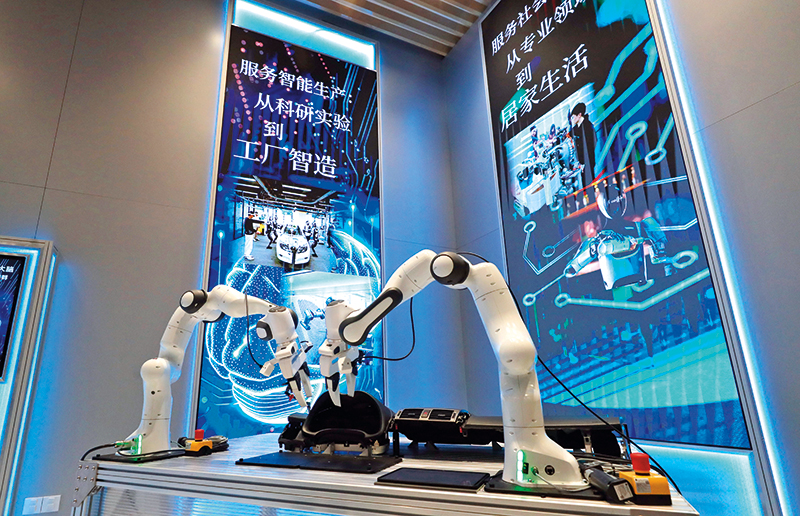
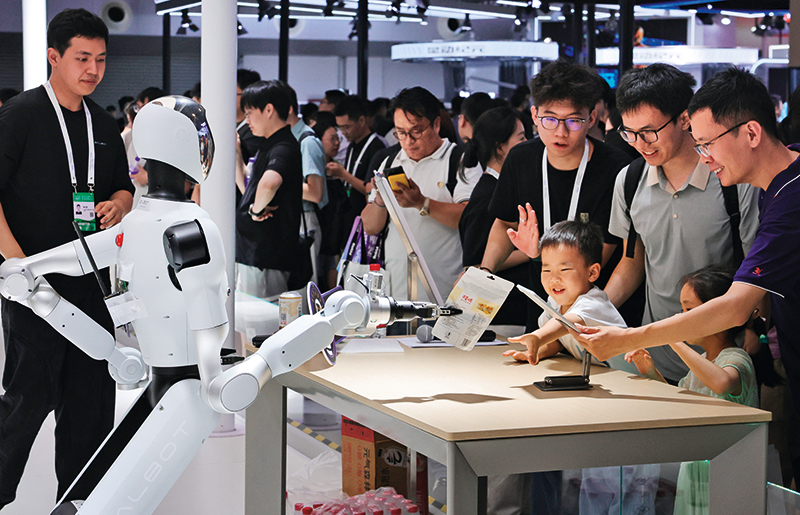
Humanoid robots boxing, robotic dogs picking up trash, and students engaging with large models in poetry—these innovations reflect the vibrant AI industry in Shanghai. In July 2025, the eighth World Artificial Intelligence Conference will be held in Shanghai, showcasing the city’s dynamic AI industry.
According to Song Haitao, director of the Shanghai Artificial Intelligence Research Institute, one reason AI is considered a “young” industry is that it is at a critical juncture of transitioning from the laboratory to production and daily life, where technology iteration and application adaptation are not yet fully defined, presenting opportunities for competition and collaboration.
China has established a vast industrial system covering all 41 industrial categories, maintaining the world’s largest manufacturing scale for 16 consecutive years. In 2024, China’s data production reached 41.06 zettabytes, accounting for 26.67% of the global total. “China possesses a complete industrial system, massive data resources, and a broad application market, providing a solid foundation for deep AI empowerment,” said Wu Tongning, deputy director of the AI Research Institute of the China Academy of Information and Communications Technology.
Strategic Growth and Policy Support
During the 14th Five-Year Plan period, Shanghai’s GDP is expected to grow by an average of 4.9% annually, reaching 5.67 trillion yuan, ranking among the top five global cities. As a front line of China’s reform and opening-up and a deeply connected global metropolis, Shanghai has a solid industrial foundation, diverse consumption scenarios, rich talent resources, and efficient urban governance.
With comprehensive and effective policy supply, precise and efficient element allocation, and complementary spatial layout advantages, Shanghai is strategically creating a complete ecological closed loop covering policies, funding, computing power, data, and space for the young AI industry.
Focused Breakthroughs and Innovation
Shanghai is focusing on key technologies and infrastructure, particularly large models, which are crucial for driving AI development. By implementing various support plans for large models, the city aims to enhance innovation capabilities, improve the supply level of innovation elements, and promote the application of large models.
Following the “Model Speed Shanghai” action plan, Shanghai is building intelligent computing clusters, data supply systems, and practical training grounds, focusing on key sectors such as finance, manufacturing, education, healthcare, cultural tourism, and urban governance to accelerate application empowerment.
The Shanghai Municipal Cyberspace Administration reported on April 3 that the city added seven newly registered generative AI services, increasing the total from 150 to 157 in just over half a month since the announcement.
Comprehensive Innovation and Ecosystem Development
Shanghai is achieving differentiated layouts through “East-West linkage,” creating a development environment with “low innovation costs and high intellectual density” that promotes the full-chain development of the AI industry. In Pudong New District, nearly 200 upstream and downstream ecological enterprises are focusing on embodied intelligence and vertical applications. In Xuhui District, the number of companies in the large model ecosystem has increased from over 100 in 2024 to over 200 in 2025, with more than 20 potential unicorns valued at over 1 billion yuan. Currently, Xuhui District has gathered over 1,700 AI-related companies, including over 900 large model companies.
Recently, Shanghai’s AI sector has seen significant achievements. At the end of the year, companies like Muxi Co., Biran Technology, and TianShu Smart Chip made their debut on the Science and Technology Innovation Board and the Hong Kong Stock Exchange. Following this, large model company Xiyu Technology also went public in Hong Kong. On March 28, the first general embodied robot, the A3, from the leading company Zhiyuan Robotics, was officially launched, just over three months after the 5,000th unit was produced.
“From foundational computing chips to upper-level AI large models and embodied intelligence, Shanghai is showing a vigorous momentum of full-stack innovation and comprehensive breakthroughs in service of national strategies,” said Tang Wenkang, director of the Shanghai Economic and Information Commission.
Enhancing Element Supply and AI Ecosystem
To ensure that “good models are not lacking in computing power, good applications are not lacking in data, and good products are not lacking in chips,” Shanghai is systematically enhancing support for key elements, strengthening the collaborative development of high-performance intelligent computing chips, high-quality data, and efficient intelligent computing clusters, laying a solid foundation for the iteration of large models and the maturation of embodied intelligence technology.
To address the challenges faced by large enterprises in finding computing power and small enterprises in the high costs of using computing power, Shanghai has established the largest computing power scheduling platform in the country, allocating 1 billion yuan in computing power vouchers annually to help enterprises quickly and cost-effectively access the city’s 140,000 P of heterogeneous computing power.
For the high-quality data urgently needed by model enterprises, Shanghai has built the country’s first data operation platform, focusing on key areas such as AI for Science (AI4S), industrial manufacturing, and embodied intelligence, aggregating 10,000 TB of datasets and connecting 100,000 developers at home and abroad.
Shanghai has included AI talent in the city’s key industry talent reward program, listing “AI trainers” among the urgently needed high-skilled talent categories. By 2025, 16,300 individuals participated in AI trainer skill evaluations, with 10,900 obtaining vocational skill certificates.
Investment and Support for Startups
In terms of investment, Shanghai is leading the establishment of functional sub-funds focusing on computing power and data, guided by the national AI fund and municipal AI mother fund, creating a financing supply system from seed to maturity. In January 2026, large model unicorn company Jueyue Xingchen completed over 5 billion yuan in Series B+ financing, setting a record for the highest single financing amount in the Chinese large model sector in the past 12 months.
Additionally, Shanghai is actively opening scenarios to empower AI enterprises. Recently, the Shanghai State-owned Assets Supervision and Administration Commission opened 50 scenario challenges from eight key state-owned enterprises, including Shanghai Electric and Shanghai Port Group, to support diverse innovative entities in entering real scenarios and accelerating the formation of a technology-business closed loop.
Empowering Young Innovators
During the Spring Festival of 2026, Wang Diany, a doctoral student at the Shanghai Institute of Intelligent Innovation, led the development of a lightweight unified multimodal model, DeepGen 1.0, which topped the Hugging Face trends list.
“In our academy, we don’t just judge by papers; influence comes from research, development, industry, and society, such as download volumes of models and data, and investment amounts from leading funds. Each project is practical,” Wang said.
Seizing the historical opportunity in AI development, Shanghai is systematically optimizing talent cultivation and technological innovation paradigms, proactively laying out early-stage investments, and empowering new production relationships like “one-person companies,” fostering an innovative ecosystem that tolerates trial and error and supports growth, allowing young people to explore their talents under the guidance of top faculty, patient capital, and industry scenarios.
The Shanghai Institute of Intelligent Innovation aims to cultivate top AI talent through a collaborative approach of research, development, and education, supported by substantial funding and infrastructure for disruptive innovation. The institute has successfully incubated 24 high-value enterprises, with a total valuation exceeding 3 billion yuan.
AI is optimizing research paradigms, facilitating climbers on their “mountain climbing” journey. This year, leveraging the Shanghai Artificial Intelligence Laboratory’s “AGI4S Mount Everest Plan,” Shanghai has opened channels for computing power, data, models, platforms, scenarios, projects, and talent cooperation, constructing a national hub for AI4S.
Innovations in Research and Development
The “amplification effect” has been a significant technical challenge in new material research. Previously, building factories of various scales required substantial time and effort to verify formula feasibility. The Shanghai Artificial Intelligence Laboratory has collaborated with China National Offshore Oil Corporation and China University of Petroleum to form a joint research team, utilizing the cross-scale generalization capability of large models to build a “molecular-grid industrial intelligent agent,” successfully applying AI to specific industrial processes. This effectively provides a “super research assistant” for the development of energy storage materials, addressing the “impossible triangle” of energy efficiency, safety, and lifespan, with research results deployed in megawatt-level power stations.
The DeepLink super-intelligent computing platform breaks down barriers between traditional supercomputing and intelligent computing, creating a “computing power map” that makes scheduling diverse heterogeneous computing resources as convenient as using water and electricity. The Sciverse scientific intelligence database has high-fidelity parsed over 25 million scientific documents, with plans to reach a scale of 100 PB, achieving comprehensive coverage of China’s graduate discipline system and providing high-accuracy, timely AI-ready data support for scientific discovery. The new embodied autonomous experimental platform connects the “last mile” from “simulation” to “verification,” autonomously completing complex physical transport and precise experimental operations, significantly shortening research cycles that previously lasted years. The Shanghai Artificial Intelligence Laboratory is exploring the creation of an “intelligent foundation” to support researchers nationwide, marking the beginning of a “Shanghai story” in leading a paradigm shift in scientific research through AI.
Early Investment and Support for Startups
Shanghai has established a 10 billion yuan leading AI industry mother fund at the municipal level and a 2 billion yuan AI youth entrepreneurship fund in Xuhui District, along with a private equity fund of over 5 billion yuan for intelligent computing. These investments provide crucial support for AI startups facing funding gaps, helping them achieve significant breakthroughs.
In one late-night meeting in 2023, the investment team of Shanghai Guofang Private Equity Fund Management Company decided to anchor its long-term value in hard technology breakthroughs, despite the short-term fluctuations in the “hundred model war,” ensuring that Shanghai retains its innovative spark in AI.
In just four years, Xiyu Technology, with an average employee age of 25, has served over 230 million users across more than 200 countries and regions, with 214,000 enterprise users and developers, and over 70% of its revenue coming from overseas. The company’s founder, Yan Junjie, noted that the Shanghai government at all levels has a comprehensive understanding of the AI industry and maintains an open and inclusive attitude, nurturing “seedling” enterprises from the ground up.
Moreover, targeting the booming “one-person company” trend, Xuhui District issued measures at the end of 2025 to support deep AI applications, including full waivers of workspace fees for the first year, monthly housing subsidies of up to 2,000 yuan for up to three years, and up to 1 million yuan in computing power, model, and data vouchers, with a “pay-as-you-go” model for computing support.
“In the past, we focused on ‘selecting saplings and picking fruits’; now we emphasize ‘breeding and nurturing, fertilizing and irrigating,’ investing early, investing small, investing in hard technology, and investing for the long term, allowing for trial and error and being tolerant of failure,” said Chen Yong, deputy mayor of Xuhui District, emphasizing that Shanghai values long-term growth and the nurturing of young talent in AI.
The leading AI industry mother fund has maintained a high investment intensity since its establishment in July 2024, with investment decisions exceeding 7 billion yuan. By 2025, one in four AI companies in Shanghai that received financing had received investment from the leading ecological fund.
Seizing the High Ground of AI Industry Applications
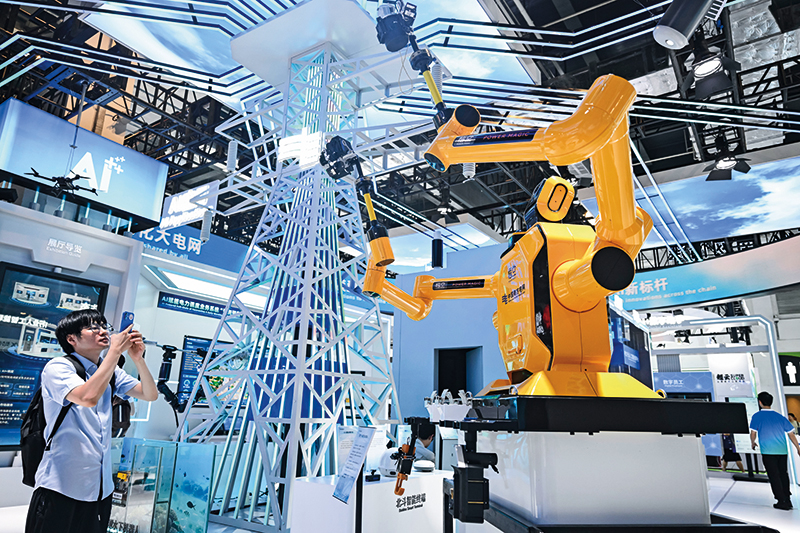
At Yangshan Port, unmanned terminals are setting efficiency records; the industrial digital public service platform “Haizhi Online” is helping 800,000 small and medium-sized enterprises upgrade their global order capabilities; and companies like Jingtai Technology are using autonomous experimental platforms to enhance the efficiency of drug molecule screening and synthesis by dozens of times. The rapid development of AI is intersecting with China’s efforts to cultivate new productive forces and promote economic and social transformation, making it urgent and strategic to enhance the intelligent level of economic and social development through “AI+” initiatives.
Shanghai is deeply implementing the “AI+” initiative, strengthening the integration of AI with industrial development, social welfare, and urban governance, seizing the high ground of AI industry applications, and empowering various sectors comprehensively.
Strengthening Dual Empowerment
By recently introducing the first humanoid intelligent robot employee, “Nengzi No. 1,” into the Buick Zhijing E7 battery production line, SAIC Group exemplifies the dual empowerment of AI and industrial development: manufacturing enterprises introduce cutting-edge technology to solve production line pain points and enhance intelligent manufacturing levels, while AI companies gain real-world scenario validation opportunities to accelerate technology maturity and commercialization.
Manufacturing is the foundation of Shanghai’s establishment and a broad stage for the large-scale application of AI. In 2025, the total output value of Shanghai’s strategic emerging industries is expected to grow by 6.5% year-on-year, accounting for 45% of the total industrial output value, nearing half of the total. Zhang Ying stated that Shanghai is focusing on the deep integration of AI and manufacturing, including collaborative research and development of industrial models, intelligent agents, and intelligent equipment products, and supporting enterprises in intelligent transformation and upgrades across various stages such as research and design, production, and supply chain management.
Currently, Shanghai has cultivated over 300 advanced intelligent factories, ranking first in the country for the number of national-level intelligent factories for several consecutive years, and leading the Yangtze River Delta in the intelligent manufacturing development index.
Enhancing Urban Governance with Digital Foundations
With approximately 25 million permanent residents, Shanghai is one of the most densely populated megacities globally. The city is committed to being resident-demand oriented, adapting to the trend of digital intelligence, innovating governance concepts, models, and methods, and enhancing technological support to continuously improve the intelligence and precision of urban governance.
By the end of 2025, Shanghai’s “One Network for All Services” will have integrated 3,827 items, with the actual online handling rate increasing from less than 20% six years ago to over 80%. Building on this, Shanghai is fully promoting “AI+ government services” and “AI+ spatial governance,” integrating AI into the fine management of urban governance, creating a new model of digital governance for megacities that leads the nation.
Xuhui District has achieved refined mapping of 600,000 layered household units through integrated data collection and generative AI three-dimensional reconstruction technology, establishing a dynamic urban governance hub linking “people, housing, industry, goods, and affairs.”
Pudong New District is the first in the country to explore the construction of a digital airport for drones, innovating intelligent regulation applications for drones, and creating new models for automatic drone patrols, data transmission, intelligent identification of violations, and non-site law enforcement.
Putuo District is focusing on high-frequency scenarios such as policy inquiries, service guides, and intelligent Q&A, using AI and large language models as a technical foundation to create a closed loop of “intelligent Q&A—knowledge sharing—efficiency enhancement,” driving the transformation of grassroots governance from experience-driven to data-driven.
Tang Wenkang stated that from optimizing intelligent traffic systems to enhancing citizen service efficiency, from fine management of the urban brain to safeguarding urban safety, AI effectively empowers the modernization of megacity governance and will assist Shanghai in becoming an international digital capital.
Enhancing Elderly Care Services with AI
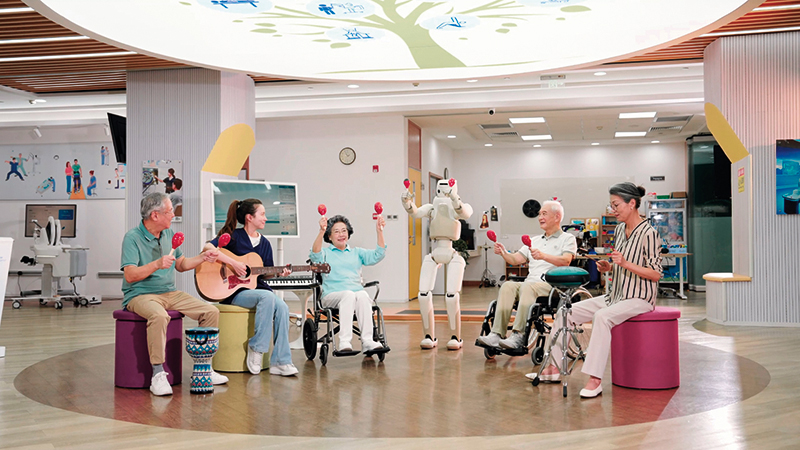
In Shanghai, the population aged over 60 exceeds 5.7 million, accounting for 37.6% of the city’s total population. In response to the significant demand for elderly care and limited caregiving resources, AI is becoming a key variable in addressing the challenges of an aging population. Shanghai is strengthening technological research, product development, and service platform construction to promote the demonstration and promotion of innovative products, providing technological support for the growing high-level, multi-layered, and personalized elderly care needs.
In 2025, the first “AI+ Elderly Care Experience Center” will be established in “Model Speed Space,” showcasing elderly care technology products from various resident enterprises, allowing local seniors to experience cutting-edge applications such as AI companion robots, intelligent health management, and remote medical consultations right at their doorstep.
Liu Guojian, deputy director of the Shanghai Civil Affairs Bureau, introduced that since 2023, Shanghai has been fully promoting the construction of smart elderly care homes. As of February this year, 122 smart elderly care homes have been established, effectively reducing the repetitive labor of caregivers and improving the quality and efficiency of care services through digital care plans and records, as well as the use of pill dispensing systems and assistive robots.
Contributing Shanghai’s Solutions to AI Governance
In 2024, the Qingpu District Court in Shanghai investigated 400 trademark infringement cases related to malicious evidence collection using AI “hallucinations,” uncovering the truth behind some individuals using AI large model technology for “false” evidence collection, setting a benchmark for judicial fairness in the AI era.
Shanghai consistently balances innovation with regulation, continuously strengthening legal safeguards, governance collaboration, and open cooperation, actively contributing “Shanghai solutions” to global AI governance.
Legislative Initiatives
Legislation is a priority, establishing a foundation for development with an inclusive and prudent approach. As the first provincial-level local regulation in China’s AI field, the “Shanghai Regulation on Promoting AI Industry Development” not only defines the industry, delineates responsibilities, and outlines support directions but also embodies a governance philosophy of inclusiveness and prudence—specifically requiring the “activation of innovation vitality among various entities,” allowing a degree of trial and error for new business models in exploratory stages, while clarifying bottom-line boundaries and leaving space for technological innovation, signaling a commitment to stability and confidence in industry development through legal certainty.
Enhancing Judicial Governance
Shanghai’s judicial authorities are continuously exploring ways to improve the governance of AI-related crimes. In 2025, the Xuhui District People’s Procuratorate and the Xuhui Branch of the Shanghai Public Security Bureau jointly released guidelines for electronic data collection and review in criminal cases involving generative AI, marking the first systematic construction of electronic data collection and review standards in the field of generative AI crime by Shanghai’s judicial authorities. This not only fills a regulatory gap but also promotes a new model of judicial governance that combines “technology + law.”
Internalizing Governance
Governance is internalized, promoting safety and compliance as a self-conscious aspect of enterprise development. Shanghai’s cyberspace authorities have completed the registration of 157 large models and provided one-on-one compliance guidance to over a hundred enterprises, integrating governance services throughout the entire process of industry development. Under policy guidance, more and more enterprises are realizing that safety and compliance are not only baseline requirements but also core competitive advantages for gaining market trust and achieving sustainable development.
The first offline compliance guidance service center for large models, established in “Model Speed Space,” provides enterprises with one-stop professional guidance from data security to algorithm registration. “We regularly invite regulatory authorities, legal experts, and enterprise representatives to discuss compliance paths for large models, helping enterprises accelerate their progress on the ‘safety track,’” said Yang Jingjing, chairman of Shanghai Large Model Ecological Development Co., Ltd.
Leading Technology and Governance
In an atmosphere of strengthened AI governance, some leading technology companies have pioneered a dual-driven path of simultaneous technological research and governance. For example, SenseTime’s SenseTrust governance platform offers a comprehensive solution from data governance to application governance. This platform achieves over 95% detection rates for toxic data in the data preprocessing stage and effectively identifies data bias during model training, while its “AI firewall” tool achieves a 98% detection rate for adversarial samples during application deployment.
Some companies are addressing safety from the source, embedding security concepts into the “genes” of models. Xiyu Technology has ensured complete autonomy and control from the foundational architecture of their large models, significantly reducing hallucination rates. Additionally, the company has adopted a safety governance approach of “technology governance technology, model against model,” developing specialized safety review models for content filtering.
Global Contributions to AI Governance
Shanghai is actively promoting international cooperation mechanisms for global AI governance. In January 2025, the China-BRIC AI Development and Cooperation Center’s operational base was established in “Model Speed Space,” linking AI innovation and industrial resources among BRIC countries and globally, promoting interconnectedness in the global AI ecosystem. In July of the same year, the Global Industrial AI Alliance’s Excellence Center, the first specialized international organization focusing on AI cooperation under the United Nations framework, officially entered a new stage of operationalization, attracting more international cooperation projects, technologies, resources, and talents. Additionally, the Global AI Innovation Governance Center has set its secretariat at Fudan University, aiming to create a global network for AI capability development.
“Leveraging China’s AI development practices, we collaborate with the United Nations and relevant international organizations to gather domestic and international industry-academia-research resources, jointly promoting dialogue on international AI governance, capacity building, public product supply, and youth talent cultivation, facilitating global AI governance collaboration and practical implementation,” said Yao Xu, secretary-general of the Global AI Innovation Governance Center.
Currently, Shanghai has established cooperation mechanisms in the AI field with 38 countries, promoting international AI industry connections and technological exchanges. From the banks of the Huangpu River to the world stage, Shanghai is actively building a bridge for global AI governance, becoming a shining window for Chinese wisdom to reach the world.
Comments
Discussion is powered by Giscus (GitHub Discussions). Add
repo,repoID,category, andcategoryIDunder[params.comments.giscus]inhugo.tomlusing the values from the Giscus setup tool.